Supplemental Security Income (SSI) in 2026: Eligibility & Benefits

In 2026, the Supplemental Security Income (SSI) landscape is defined by a 2.8% cost-of-living adjustment (COLA), increasing maximum federal benefits to $994 for individuals and $1,491 for couples.
These updates, effective since December 31, 2025, are crucial for millions relying on SSI for stability.
This report analyzes these benefit shifts and the ongoing debate over stagnant resource limits, providing a clear roadmap to help current and prospective beneficiaries maximize their essential support in a changing economic environment.
Understanding Supplemental Security Income (SSI) Basics for 2026
Supplemental Security Income (SSI) is a federal program designed to provide financial assistance to eligible low-income individuals who are aged 65 or older, blind, or disabled.
It is administered by the Social Security Administration, separate from Social Security retirement or disability benefits, though both are often confused.
The program aims to provide a minimum level of income to meet basic needs, ensuring a safety net for some of the nation’s most vulnerable populations.
As we approach 2026, understanding the fundamental structure of SSI becomes even more critical due to anticipated changes.
These foundational elements, including the income and resource limits, are subject to annual adjustments, which directly impact who qualifies and how much aid they receive under the Supplemental Security Income (SSI) in 2026: Eligibility Thresholds and Benefit Amounts framework.
The core of SSI eligibility hinges on an individual’s income and resources falling below specific federal limits. These limits are not static; they are regularly updated to reflect economic conditions and the cost of living.
For 2026, experts anticipate adjustments that will influence both the maximum federal benefit rate and the thresholds for countable income and resources.
These changes are crucial for current beneficiaries and those considering applying, as they dictate access to this vital support.
Staying informed about these basic principles of Supplemental Security Income (SSI) in 2026: Eligibility Thresholds and Benefit Amounts is the first step toward effective financial planning and ensuring continued qualification for benefits.
Key Definitions: Income and Resources
Income for SSI purposes includes earned income (wages), unearned income (Social Security benefits, pensions), and in-kind support and maintenance. Not all income is counted; certain types, like food stamps or some federal assistance, are excluded.
Resources refer to anything an individual owns that can be converted to cash, such as bank accounts, stocks, and real estate, with specific exclusions like a primary residence and one vehicle. The distinction between countable and non-countable assets is vital for eligibility.
These definitions directly influence whether an individual meets the financial criteria for Supplemental Security Income (SSI) in 2026: Eligibility Thresholds and Benefit Amounts, making a thorough understanding indispensable for applicants.
- Countable Income: Wages, unearned income, and in-kind support considered for eligibility.
- Non-Countable Income: Excluded income sources like SNAP benefits or certain federal programs.
- Countable Resources: Assets convertible to cash, such as bank accounts and secondary properties.
- Non-Countable Resources: Exempt assets like a primary residence and one vehicle.
Projected Eligibility Thresholds for Supplemental Security Income (SSI) in 2026
Forecasting the exact eligibility thresholds for Supplemental Security Income (SSI) in 2026 requires careful consideration of various economic indicators, primarily the Cost-of-Living Adjustment (COLA). COLA is typically based on the Consumer Price Index for Urban Wage Earners and Clerical Workers (CPI-W), which reflects inflation.
While the official numbers for 2026 will not be released until late 2025, analysts use current economic trends and historical data to project these crucial figures.
These projections are vital for individuals and families to plan effectively, ensuring they remain within the necessary financial limits to qualify for benefits.
The adjustments to these thresholds directly affect who can access Supplemental Security Income (SSI) in 2026: Eligibility Thresholds and Benefit Amounts, making their accurate estimation a key focus for beneficiaries and advisors alike.
Current economic forecasts suggest a continued, albeit potentially moderating, inflationary environment, which would likely lead to an increase in the income and resource limits for SSI.
istorically, these limits have seen incremental rises to keep pace with the cost of living.
For instance, the general resource limit for an individual has remained at $2,000 for many years, while for a couple, it is $3,000. Any changes to these figures in 2026 would represent a significant shift for applicants.
The earned income exclusion and other disregards are also anticipated to be adjusted, impacting how much income a beneficiary can earn without losing eligibility.
These projected adjustments to Supplemental Security Income (SSI) in 2026: Eligibility Thresholds and Benefit Amounts are critical for maintaining the program’s relevance and effectiveness in providing support to those in need.
Income Limits: What to Expect
The federal benefit rate (FBR) serves as the maximum monthly SSI payment and also acts as a de facto income limit for those with no other countable income.
Any income received above this amount typically reduces the SSI payment, or can even eliminate eligibility.
For 2026, a COLA-driven increase in the FBR is expected, which would consequently raise the effective income limit. This means individuals might be able to have slightly higher incomes while still qualifying for some level of SSI benefits.
Understanding these nuanced changes to the income limits is essential for navigating Supplemental Security Income (SSI) in 2026: Eligibility Thresholds and Benefit Amounts and optimizing financial support.

Resource Limits: Potential Adjustments
While the resource limits of $2,000 for an individual and $3,000 for a couple have remained unchanged for an extended period, there is ongoing legislative discussion about potentially raising these thresholds.
Advocates argue that these limits are outdated and do not reflect modern economic realities.
Any legislative action to increase these resource limits would significantly broaden eligibility for SSI, allowing more individuals with modest savings or assets to qualify.
Such a change would be a monumental development for Supplemental Security Income (SSI) in 2026: Eligibility Thresholds and Benefit Amounts.
While no concrete changes have been enacted yet, monitoring legislative proposals and discussions will be crucial for understanding potential shifts in resource limits for 2026, impacting countless potential beneficiaries.
Forecasting Benefit Amounts for Supplemental Security Income (SSI) in 2026
The actual benefit amounts for Supplemental Security Income (SSI) in 2026 are directly tied to the Cost-of-Living Adjustment (COLA), which is announced by the Social Security Administration (SSA) in October of the preceding year.
This adjustment reflects increases in the cost of living, primarily driven by inflation.
While we don’t have the definitive 2026 COLA yet, historical trends and economic forecasts provide a strong basis for projecting potential increases.
These projections are critical for beneficiaries to anticipate their future income and manage their budgets effectively.
Accurate forecasting of these benefit amounts is a key component of understanding the overall impact of Supplemental Security Income (SSI) in 2026: Eligibility Thresholds and Benefit Amounts on individual financial stability.
For 2026, assuming a moderate inflationary environment, a COLA increase is highly probable, which would lead to a rise in the maximum federal benefit rate (FBR).
This FBR is the benchmark for calculating monthly SSI payments for eligible individuals and couples.
For instance, if the COLA for 2026 is projected at 3%, an individual receiving the maximum federal benefit could see their monthly payment increase by a corresponding percentage.
These increases, though seemingly small individually, accumulate significantly over time and are crucial for meeting daily expenses.
Therefore, staying informed about the projected COLA and its implications for Supplemental Security Income (SSI) in 2026: Eligibility Thresholds and Benefit Amounts is essential for all beneficiaries.
Impact of COLA on Monthly Payments
The COLA directly influences the maximum federal benefit rate, which forms the basis of all SSI payments. When the COLA increases, the FBR also rises, leading to higher monthly payments for most beneficiaries.
This adjustment helps maintain the purchasing power of SSI benefits against inflation.
However, it’s important to note that state supplementary payments, which some states provide in addition to federal SSI, may not always increase in direct correlation with federal COLA.
Beneficiaries should monitor both federal and state announcements.
The direct impact of COLA on monthly payments is a fundamental aspect of understanding Supplemental Security Income (SSI) in 2026: Eligibility Thresholds and Benefit Amounts, ensuring payments keep pace with economic realities.
- Federal Benefit Rate (FBR): Maximum monthly SSI payment, adjusted annually by COLA.
- COLA Calculation: Based on the Consumer Price Index for Urban Wage Earners and Clerical Workers (CPI-W).
- State Supplements: Additional payments from some states, which may vary independently of federal COLA.
- Purchasing Power: COLA aims to preserve the value of benefits against inflation.
Factors Influencing SSI Changes in 2026
Several critical factors converge to shape the eligibility thresholds and benefit amounts for Supplemental Security Income (SSI) in 2026.
The primary driver is the annual Cost-of-Living Adjustment (COLA), which attempts to align benefits with inflationary pressures. This adjustment is determined by economic data from the preceding year.
Beyond COLA, legislative actions and budgetary considerations can also play a significant role.
Congress occasionally debates and passes legislation that could modify SSI rules, such as resource limits or income disregards, directly impacting the program’s reach and generosity.
These multifaceted influences underscore the dynamic nature of Supplemental Security Income (SSI) in 2026: Eligibility Thresholds and Benefit Amounts and necessitate continuous monitoring for accurate information.
Economic conditions, including inflation rates, wage growth, and unemployment figures, provide the backdrop against which COLA and other adjustments are made.
A robust economy might lead to smaller COLA increases if inflation is low, while high inflation often triggers more substantial adjustments.
Demographic shifts, such as an aging population and changes in disability rates, also place pressure on the SSI program, influencing policy discussions and potential reforms.
These factors contribute to the long-term sustainability debates surrounding federal benefit programs.
Understanding these underlying influences is crucial for comprehending the complete picture of Supplemental Security Income (SSI) in 2026: Eligibility Thresholds and Benefit Amounts and their broader societal implications.
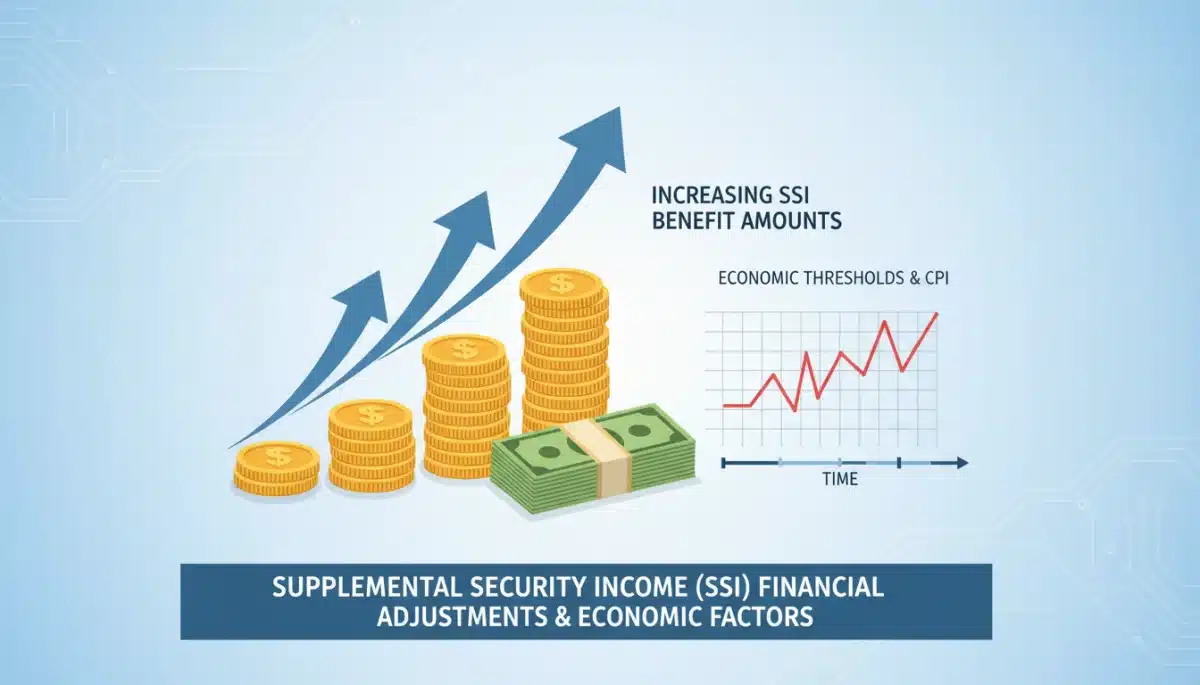
Economic Indicators and COLA Projections
The Consumer Price Index for Urban Wage Earners and Clerical Workers (CPI-W) is the benchmark used to calculate the COLA.
Economists closely watch this index, along with other inflation measures, to project the likely COLA for the upcoming year.
Forecasts for 2026 suggest a COLA ranging from 2.5% to 3.5%, depending on how inflation trends in the latter half of 2025.
This projection directly impacts the potential increase in the federal benefit rate and, consequently, the maximum SSI payment.
These economic indicators are fundamental to predicting the adjustments to Supplemental Security Income (SSI) in 2026: Eligibility Thresholds and Benefit Amounts, providing a vital tool for financial planning.
Legislative and Policy Debates
Congress frequently reviews and debates aspects of the SSI program, particularly concerning its resource limits, which have not been updated in decades.
Advocacy groups consistently push for legislative changes to modernize these limits, arguing they disproportionately affect beneficiaries.
Any significant legislative reform passed in late 2025 or early 2026 could introduce substantial alterations to the eligibility criteria or benefit calculation methods.
Such changes would profoundly impact the scope of Supplemental Security Income (SSI) in 2026: Eligibility Thresholds and Benefit Amounts.
Monitoring legislative developments in Washington D.C. is therefore essential for anyone interested in the future trajectory of the SSI program and its potential for reform.
Applying for Supplemental Security Income (SSI) in 2026
The application process for Supplemental Security Income (SSI) can be complex, requiring meticulous documentation and adherence to specific guidelines.
As we approach 2026, understanding the updated eligibility thresholds and benefit amounts will be crucial for successful applications.
Prospective applicants should begin gathering all necessary financial, medical, and personal documents well in advance.
The Social Security Administration (SSA) provides detailed instructions, and utilizing their resources can significantly streamline the application journey.
Navigating the application for Supplemental Security Income (SSI) in 2026: Eligibility Thresholds and Benefit Amounts effectively requires careful preparation and an understanding of the specific requirements.
The SSA offers multiple avenues for applying, including online, by phone, or in person at a local Social Security office.
For individuals who are aged, blind, or disabled, the application often involves an assessment of their medical condition by Disability Determination Services.
It is highly recommended that applicants seek assistance from legal aid services, disability advocates, or trusted financial advisors who specialize in government benefits.
These professionals can provide invaluable guidance, ensuring all criteria for Supplemental Security Income (SSI) in 2026: Eligibility Thresholds and Benefit Amounts are met.
Thorough preparation and expert guidance can significantly improve the chances of a successful application, minimizing delays and potential denials.
Required Documentation and Proof
Applicants must provide extensive documentation to prove their age, citizenship or legal residency, income, resources, and, if applicable, disability or blindness.
This includes birth certificates, bank statements, property deeds, medical records, and proof of other income sources.
The SSA rigorously verifies all submitted information, so accuracy and completeness are paramount. Any discrepancies or missing documents can lead to significant delays or even denial of benefits.
Having all required documentation organized and readily available is a critical step in a smooth application process for Supplemental Security Income (SSI) in 2026: Eligibility Thresholds and Benefit Amounts.
- Personal Identification: Birth certificate, valid ID, proof of citizenship/residency.
- Financial Records: Bank statements, income tax returns, proof of assets.
- Medical Evidence: Comprehensive medical records, doctor’s reports, treatment history (for disability/blindness).
- Living Arrangement Proof: Lease agreements, utility bills.
Maximizing Your SSI Benefits in 2026
Maximizing your Supplemental Security Income (SSI) benefits in 2026 involves more than just meeting the eligibility criteria; it requires a proactive understanding of how income and resources are counted and how various exclusions can be utilized.
Strategic financial planning can significantly impact the amount of assistance you receive.
Beneficiaries should regularly review their income and resource statements to ensure accuracy and identify any potential changes that might affect their payments.
Small adjustments in financial habits can sometimes lead to a more favorable benefit calculation.
Understanding the intricacies of Supplemental Security Income (SSI) in 2026: Eligibility Thresholds and Benefit Amounts is essential for optimizing your financial support.
One key strategy involves understanding income disregards, which are portions of income that the SSA does not count when determining eligibility and payment amounts.
For example, a significant portion of earned income is typically disregarded, encouraging work without immediately penalizing beneficiaries.
Additionally, setting up a Special Needs Trust (SNT) or an Achieving a Better Life Experience (ABLE) account can allow individuals with disabilities to save money or receive inheritances without jeopardizing their SSI eligibility.
These tools are invaluable for long-term financial security.
Utilizing these provisions effectively is crucial for maximizing your Supplemental Security Income (SSI) in 2026: Eligibility Thresholds and Benefit Amounts and ensuring sustained financial well-being.
Understanding Income Disregards
The SSA applies various income disregards before calculating your SSI payment. These include a general income exclusion and an earned income exclusion, which allow beneficiaries to have some income without it fully reducing their benefits.
For instance, the first $20 of most unearned income, and the first $65 plus half of the remainder of earned income, are typically not counted.
Understanding these disregards is crucial because they allow beneficiaries to engage in some form of employment or receive other forms of income without losing all their SSI.
These provisions are designed to incentivize self-sufficiency while providing essential support.
A thorough grasp of income disregards is a powerful tool for maximizing your Supplemental Security Income (SSI) in 2026: Eligibility Thresholds and Benefit Amounts and maintaining financial equilibrium.
Utilizing ABLE Accounts and Special Needs Trusts
ABLE accounts and Special Needs Trusts (SNTs) are powerful financial tools designed to allow individuals with disabilities to save money and accumulate assets above the strict SSI resource limits without losing their eligibility.
ABLE accounts allow eligible individuals to save up to a certain annual limit, with earnings growing tax-free.
SNTs, on the other hand, can hold larger sums of money and are typically used for specific needs not covered by government benefits, such as medical care, education, or personal support services.
Both options require careful planning and often the assistance of a legal professional.
These financial instruments are vital for long-term planning and ensuring that beneficiaries of Supplemental Security Income (SSI) in 2026: Eligibility Thresholds and Benefit Amounts can secure their financial future.
The Role of State Supplementary Payments in 2026
Beyond the federal Supplemental Security Income (SSI) program, many states provide their own supplementary payments to eligible beneficiaries.
These state supplements vary significantly in amount and eligibility criteria from one state to another, adding another layer of complexity to overall benefit calculations.
For 2026, beneficiaries need to be aware of how their specific state’s supplementary payment program might be adjusted, as these changes do not always align directly with federal COLA increases.
State budgetary conditions and legislative decisions are the primary drivers for these variations.
The interplay between federal and state contributions is a crucial aspect of understanding the total benefit package for Supplemental Security Income (SSI) in 2026: Eligibility Thresholds and Benefit Amounts.
Some states administer their own supplementary payments, while others have the Social Security Administration (SSA) administer them on their behalf.
The method of administration can influence how and when changes to these payments are made and communicated to beneficiaries.
It is essential for individuals to contact their state’s social services or welfare department to get the most accurate and up-to-date information regarding their specific state’s supplementary program.
Relying solely on federal SSI information may lead to an incomplete picture of total available benefits.
Understanding the role of state supplementary payments is vital for a comprehensive view of Supplemental Security Income (SSI) in 2026: Eligibility Thresholds and Benefit Amounts and maximizing total financial support.
Variations by State
The amount of state supplementary payments can differ widely, ranging from minimal additional support to substantial increases that significantly boost a beneficiary’s total income.
These variations are often influenced by the state’s cost of living, political priorities, and fiscal health.
For example, states like California and New York typically offer higher state supplements compared to other states, reflecting their higher cost of living. Conversely, some states offer no supplementary payments at all.
These state-specific variations highlight the importance of localized research when assessing your total potential income from Supplemental Security Income (SSI) in 2026: Eligibility Thresholds and Benefit Amounts.
Challenges and Future Outlook for SSI in 2026
The Supplemental Security Income (SSI) program faces ongoing challenges, including the need to modernize its outdated resource limits and address the adequacy of benefit amounts in an increasingly expensive economic environment.
These issues are frequently debated in legislative circles and among advocacy groups.
As we look towards 2026, discussions around potential reforms are likely to intensify, driven by calls for greater equity and efficiency within the program. The future outlook for SSI will depend heavily on legislative will and economic stability.
Addressing these challenges is critical for ensuring the long-term viability and effectiveness of Supplemental Security Income (SSI) in 2026: Eligibility Thresholds and Benefit Amounts.
One of the most persistent challenges is the low resource limit, which has remained at $2,000 for individuals and $3,000 for couples for decades.
This limit prevents many low-income individuals from saving for emergencies or future needs without risking their eligibility.
Advocates argue that raising these limits would not only ease financial burdens on beneficiaries but also align the program more closely with contemporary economic realities.
The outcome of these policy debates will significantly shape the future of SSI.
The future outlook for Supplemental Security Income (SSI) in 2026: Eligibility Thresholds and Benefit Amounts is intrinsically linked to the resolution of these long-standing structural issues.
Advocacy for Modernization
Numerous organizations and individuals are actively advocating for the modernization of the SSI program, particularly focusing on increasing the resource limits and improving the overall benefit adequacy.
These efforts aim to make SSI more responsive to the needs of its beneficiaries.
Legislative proposals have been introduced in Congress to address these issues, though progress has been slow. The push for reform highlights the recognition that the current structure of SSI can create barriers to financial stability for many.
The continued advocacy for modernization plays a crucial role in shaping the future of Supplemental Security Income (SSI) in 2026: Eligibility Thresholds and Benefit Amounts.
| Key Aspect | Brief Description |
|---|---|
| Eligibility Thresholds | Income and resource limits expected to adjust based on COLA and potential legislative changes. |
| Benefit Amounts | Federal Benefit Rate (FBR) to increase with 2026 COLA, impacting monthly payments. |
| Application Process | Requires thorough documentation and understanding of updated 2026 criteria. |
| Maximizing Benefits | Utilize income disregards, ABLE accounts, and Special Needs Trusts for financial planning. |
Frequently Asked Questions About SSI in 2026
The primary changes expected for Supplemental Security Income (SSI) in 2026: Eligibility Thresholds and Benefit Amounts are adjustments to income limits, driven by the Cost-of-Living Adjustment (COLA). While resource limits have remained static, there’s ongoing advocacy for legislative changes to increase them, which could significantly impact who qualifies. Beneficiaries should monitor official SSA announcements for precise figures.
The COLA for 2026 will directly increase the maximum federal benefit rate (FBR) for Supplemental Security Income (SSI) in 2026: Eligibility Thresholds and Benefit Amounts. This means most beneficiaries will see a rise in their monthly SSI payments, helping to offset inflation. The exact COLA percentage will be announced by the Social Security Administration in late 2025.
Yes, you can work and still receive Supplemental Security Income (SSI) in 2026: Eligibility Thresholds and Benefit Amounts, thanks to income disregards. The SSA excludes certain portions of your earned income, allowing you to maintain some employment without losing all your benefits. Understanding these disregards is key to maximizing your combined income from work and SSI.
ABLE (Achieving a Better Life Experience) accounts allow eligible individuals with disabilities to save money and accumulate assets above the strict SSI resource limits without losing their benefits. These accounts are a crucial tool for financial planning, enabling beneficiaries to save for future needs while remaining qualified for Supplemental Security Income (SSI) in 2026: Eligibility Thresholds and Benefit Amounts.
State supplementary payments, which are additional benefits provided by some states, may or may not increase in 2026. These adjustments are determined by individual state legislatures and budgetary conditions, not directly by the federal COLA. Beneficiaries should consult their state’s social services agency for specific information regarding their state’s Supplemental Security Income (SSI) in 2026: Eligibility Thresholds and Benefit Amounts.
Looking Ahead
The unfolding landscape of Supplemental Security Income (SSI) in 2026: Eligibility Thresholds and Benefit Amounts presents both continuity and potential for significant change.
While COLA-driven benefit increases are a near certainty, the critical debates surrounding outdated resource limits continue to shape the program’s future.
Beneficiaries and prospective applicants should remain vigilant, closely monitoring official announcements from the Social Security Administration and legislative developments.
Proactive financial planning, coupled with an understanding of current and projected SSI rules, will be essential for navigating these changes effectively and securing vital financial support for those who need it most.
For the most up-to-date information on rules and to start an application, visit the official Supplemental Security Income (SSI) portal.